The WhatsApp Quotation Problem
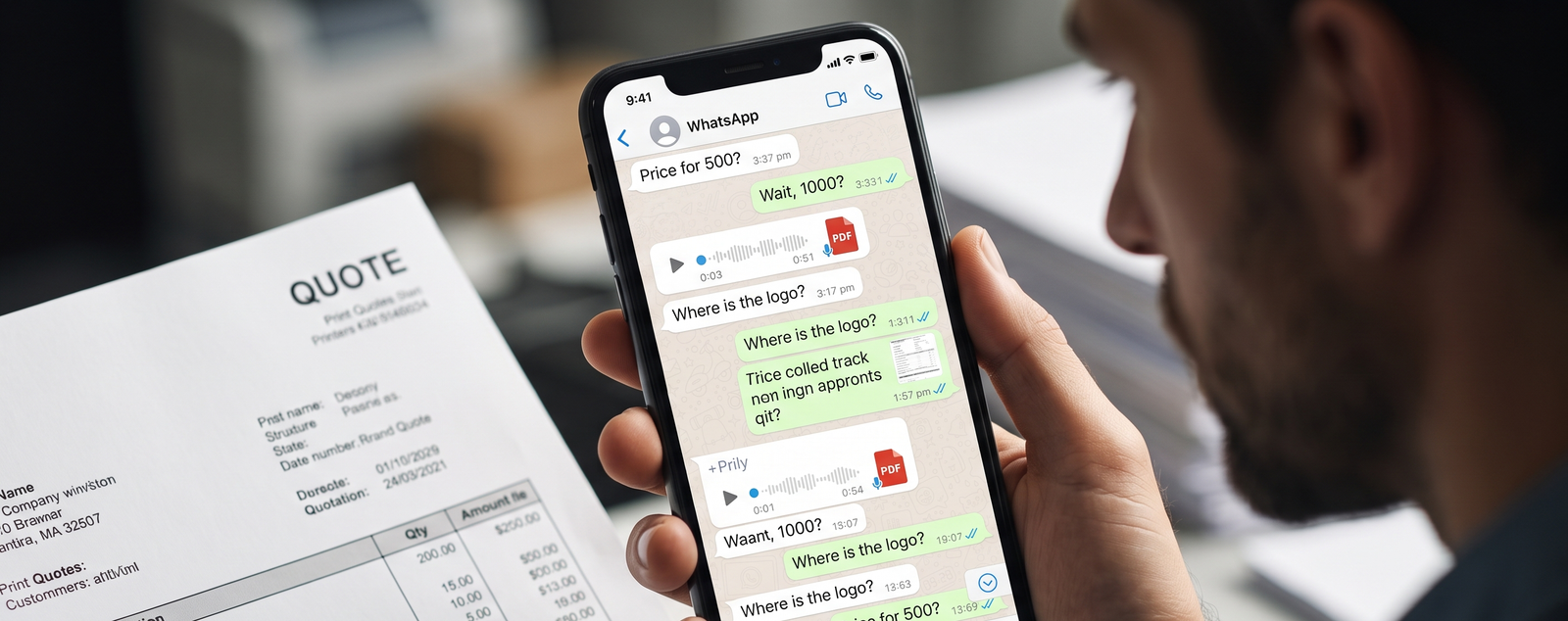
A customer calls. Asks the rate for a 10 by 5 flex banner with a frame. The owner, mid-conversation with someone else, quickly says ₹28 a square foot. Two weeks later, a different staff member quotes the same customer ₹32 for the same thing. The customer notices immediately. Now there is a trust problem that has nothing to do with the printing quality at all.
The Problem: The Rate Lives in Someone's Head
In most printing shops, pricing is not written down in one place that everyone uses. It is a mix of memory, an old notebook, a rough sense of "what we usually charge," and whatever the person answering the phone happens to remember that day. Add frames, rivets, lamination and different material grades into the mix, and the room for two different answers to the same question grows very quickly.
This is not a small business problem. It is the single most common reason a printing customer starts distrusting a shop, not bad printing, but inconsistent pricing. Once a customer catches two different quotes for the same job, every future price they are given gets questioned, even when it is completely fair.
For the shop, it also means every quotation takes longer than it should. Someone has to think, sometimes call the owner to check, sometimes guess. A process that should take thirty seconds stretches into a five-minute back-and-forth, and busy customers move on to whoever answers fastest.
"We were not trying to overcharge or undercharge anyone. The problem was simply that three different people were quoting rates from memory, and memory is not consistent. Once we had one rate card everyone used, the arguments about pricing just stopped."
A common experience among multi-staff printing shops
How a Rate Card Fixes This, Not Just for One Person, for Everyone
Leo Ink's rate card is built around exactly this problem. Every material, flex, star flex, vinyl, sunboard, backlit, has its rate entered once, by the owner, for square feet, running feet or per piece, whichever applies. Frame types and rivet pricing are set the same way, entered once in the master and simply selected afterwards, never retyped or recalculated by memory.
When any staff member creates a quotation, the correct rate appears automatically the moment they select the material. They are not guessing, not calling the owner to confirm, and not relying on what they remember from three weeks ago. If a specific customer has a negotiated rate, that rate applies automatically for them and nobody else, so a long-standing customer's agreed price is protected without needing a special conversation every time.
The rate remains editable if a genuine one-off adjustment is needed, but the starting point is always correct. A shop is no longer dependent on one person's memory being available and accurate at the exact moment a customer calls.
What Changes on the Ground
- Every staff member quotes the same customer the same rate, whether the owner is in the shop or not
- A thirty-second quotation stays a thirty-second quotation, even for a new hire on their first week
- Negotiated rates for regular customers apply automatically, with no separate note-taking required
- Frame and rivet pricing stops being a mental calculation and becomes a simple selection
The Result
The real change is not speed, though quotations do get faster. It is trust. A customer who gets the same answer today that they got last month stops questioning every price they are given, and starts calling back for the next job without hesitation. For the shop, it means the owner is no longer the single point of failure for every pricing decision, the business can run a full day without him fielding rate questions on the phone.
Key Takeaways
- ✓Every staff member quotes the same customer the same rate.
- ✓A thirty-second quotation stays a thirty-second quotation.
- ✓Negotiated rates for regular customers apply automatically.